In this article
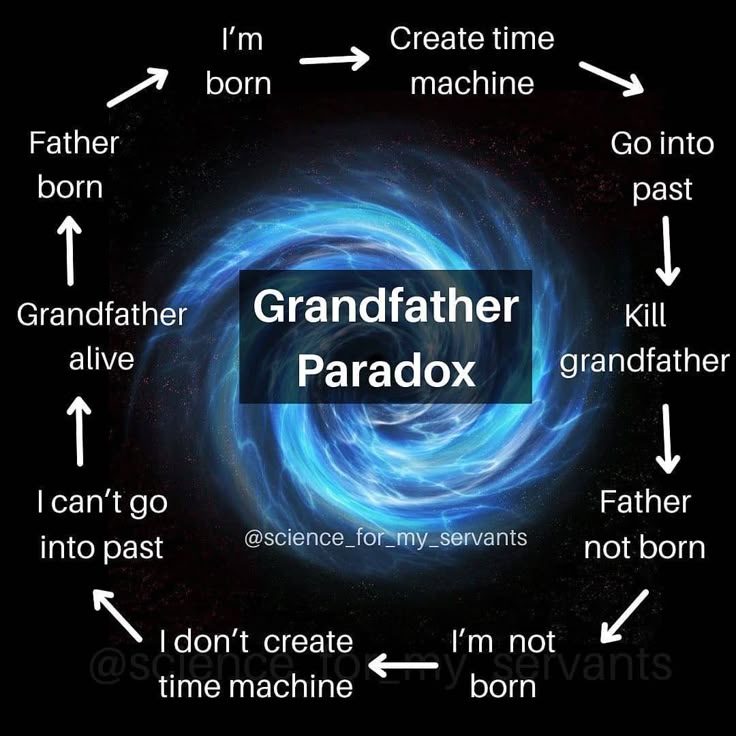
The Grandfather Paradox

Imagine discovering a time machine. Naturally the first thing you would probably do is go back and meet your younger self. Or see dinosaurs. Or buy Bitcoin before everyone else.Ot if you're feeling particularly chaotic go back and stop your grandfather from ever meeting your grandfather.
And that's where the universe starts having a nervous breakdown . The Grandfather Paradox is one of those philosophical problems that sounds like a joke until you actually think about it. Imagine you travel back in time and somehow prevent your grandfaster from meeting your grandmother.
They never marry. Your parent is never born. You are never born. But if you were never born. Who travelled back in time to prevent them from meeting?
Congratulations, you have just made the universe's worst family tree.
The problem is that your action creates a contradiction. You existed because your grandparents met. You went back in time because you existed.You prevented them from meeting . Therefore you never existed.
Therefore you couldn't have gone back. Therefore, they met. Therefore, you existed. And now we're going in circles so aggressively that even a mathematician might need a coffee.
This is the fascinating part about time travel. We usually imagine time as a straight road. Yesterday is behind us. Today is where we are Tomorrow is ahead. Simple
But if time travel is possible . Suddenly the road starts folding over itself like a badly designed charging cable. Your futher could change your past. Your future past could erase your future. And your wraaes future could prevent your from changing the past in the first place.so what happens?. One possibility is that the past simply cannot be changed. You could travel back and try everything imaginable to stop your grandparents from meeting
Maybe something would always go wrong.
You spill coffee on your grandfather causing him to leave the cafe five minutes later - which somehow makes him meet your grandmother somewhere else. You lock him inside his house. He climbs through the window. You hide his shoes. He walks barefoot.
You eventually realize that the universe itself seems to be your grandmother's biggest wingman. Another possibility is that changing the past creates an alternate timeline. You stop your grandparents from meeting. In that new timeline. You are never born.
But the original version of you still exists because you came from the original timeline. So congratulations. You have successfully created a universe where your family doesn't exist qhilebpersonially standing there as evidence that they once did.
The third possibility is evensrranger. Perhaps really somehow allows contradictions rthat we simply don't understand. Andhonestly, that might be the most terrifying option.because the paradox, isn't reallynjust about time travel.
It exposes how dependent our existence is on events we had absolutely no contral over. You existnbecause two people met, And their parenrs existed because of countless other meetings, accidents., decisions, migrations, wars, friendships,illnesses and completely random moments.
Change one day event farnempugh back, and the entire chain could look different.. Maybe your existence is not the inevitable result of history. Maybe it is the result of an absurdly complicated series of coincidences that somehow ended with you sitting here reading this.
The Universe Is Too Big to Be This Quiet

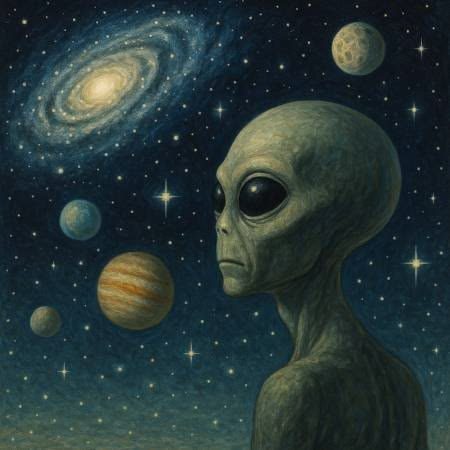
Look up at the night sky.Those tiny points of light look peaceful. Beautiful Almost innocent. They are not. Every one of rhousebsrars is a potential reminder that planet in an absurdly enormous universe.
There are hundreds of billions of stars in our galaxy alone. Many have planets. Some of those planets may have conditions suitable for life. And there are hundreds of billions of galaxies beyond ours. So statistically the universe should be crawling with something.
Aliens, Civilizations, Strange creatures. Intergalactic accountants complaining about taxes. Something. And yet...
Silence. No confirmed alien message
No mysterious spacecraft parking outside Earth,. No extracterrestrial civilization sending us a polite email saying. "Hello humans congratulations on inventing Wi-Fi" Nothing.
This uncomfortable mystery is known as the Fermi Paradox. Named after physicist Enrico Fermi. who famously questioned, essentially: "Where is everybody?" The quetion sounds simple. It isn't
If intelligent life is even moderately common, and the universe is billions of years old, then some civilizations head start on us. Earth is only about 4.5 billion years old. The universe is around 13.8 billion years old.
That's a ridiculous amount of time. Imagine humanity discovering electricity ,computers, space travel and artificial intelligence within a few centuries. Now imagine a civilization that had a million-year head start. What could it becomes?
It could potentially spread throughout its galaxy . Build enormous structures. Send signals across space. Create technologies we can't even imagine. Yet when we look outwand. We don't see obviousvwvidence of any of it.
And that is where things become uncomfortable. Maybe intelligent life is extremely rare. Perhaps Earth won the cosmic lottery. Maybe simple life appears frequently. But intelligent life almostbnever develops.
Or perhaps civilizations become intelligent and then destroy themselves. Warb. Environmental collapse. Runaway technology. Artificial intelligence. Resources shortages. Something else we haven't even imagined.
This possibility is sometimes connected to the idea of a Great filter- a stage in the development of life that is extremely difficult to pass.Maybe the filter is behind us. Perhaps getting from simple organisms ro intelligent life is unbelievably unlikely.
That would actually be good news, it would mean we already survived the hardest part.But what if the Great Filter is ahead of us?. What if civilizations commonly reach the point where they become technologically powerful and then destroy themselves?.
That possibility is much darker. Maybe the universe isn't quiet because nobody is there . Maybe it is quiet because everyone eventually disappears. There is another possibility.
If a human walks past and ant colony carrying a smartphone the anta might notice the shadow. They might notice vibration.
But they have no idea what the object is . Perhaps as an ed civilizations could exist around us in forma our brains and instruments aren't capable of recognising.
Or perhaps we're simply early. Maybe humanity is among the first intelligent civilizations to emerge. Maybe somewhere billions of years from now another species will look toward our deadline galaxy and wonder. "Was anyone ever there?".
That thought is strangely humbling . We spend our lives arguing about celebrities, politics , money, status and who viewed whose story. Meanwhile above us is an incomprehensibly large universe that has been expanding for billions of years.
And nobody has answered the most ridiculous question of all Where is everybody? Maybe we're alone. Maybe we're not. But until we know the silence remains one of the strangest things in existence.
Because the universe is not small. It is not young. It is not empty of possibilities. And yet, when we listen..
Nothing answer.
When Does Change Actually Become Change?

Imagine you are holding a pile of sand. A proper-pile. A respectable pile. The kind of pile that looks like it has its life together. Now remove one grain.
Is it still a pile?. Obviously. Remove another . Still a pile. Another Strll. You could keep doing this for quite a while. At some point, however you are holding only a few grains.
Then one. Then nothing. So here is the problem. At what exact moment did the pile stop being a pile?. There must have been a final grain. The grain that, when removed transformed your perfectly respectable pile into.. not a pile.
But which grain?. The 10,000th?. The 1,000th?. The 100th. The 2nd?. Surely removing one tiny grain cannot suddenly create a dramatic philosophical transformation.
And yet, if removing one grain never makes a difference then apparently you can remove every grain individually and somehow still have a pile at the end. Congratulations . You have discovered a pile of absolutely nothing.
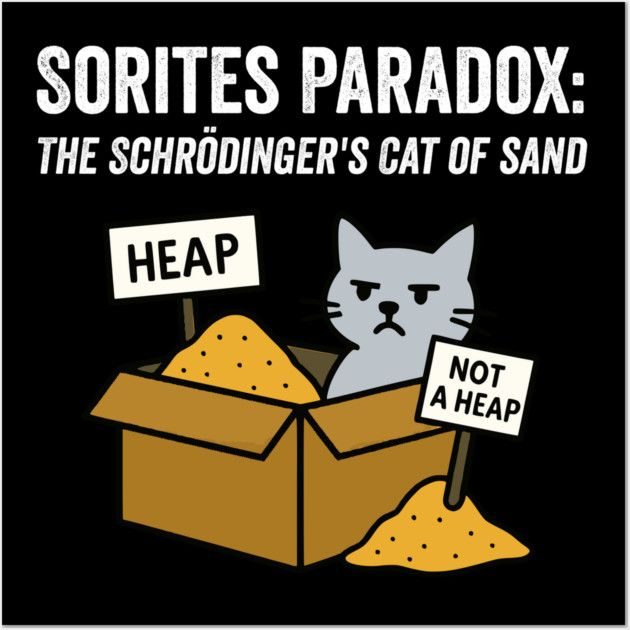
This is the Sorites Paradox an ancient philosophical problems associated with Enbulides of Miletus. And although it begins with sand, it becomes much more uncomfortable when you apply it to real life..
Take money . When does someone becomes rich?. Is ₹1 lakh rich?. What about ₹ 10 lakh?₹1 crore? ₹10 crore? There isn't something magical bank balance where the universe sends you a notification.
"Congratulations. You are officially wealthy."
The same problem appears with age. When does someone becomes old?. You don't wake up on your 60th birthday and suddenly transform into an elderly person. The change is gradual. One year Another year . Another.
Nothing dramatic happens at midnight. Yet eventually. We use completely different words to describe the person. We do this everywhere. When does a person become beautiful?. When does someone become overweight?.
When does a friendship become a relationship? When does being stressed become burnout?. When does being confident become arrogant? When does being careful become paranols?. When does being successful become wealthy?
Reality rarely gives us clean borders. Human language does. And that's where things get messy. We like categories because categories make the world easier to understand.
Young.Old. Rich . Poor. Healthy. Sick. Successful. Failure. Friend. Stranger. But nature doesn't always respect our labels.
Imagine watching a tree grow . Therevis no single second when it stops being a sapling and becomes a tree. There is simply change. Slow, continuous , almost invisibile change. And perhaps that's why the Sorites Paradox is more relevant to our lives than we realize.
We often wait for dramatic moments to tell us that something has changed. We think we'll know when we've become a different person. But transformation rarely announces itself. You don't suddenly became more confident.
You don't suddenly become distant from someone. You don't suddenly become exhausted. You don't suddenly grow up.bit happens through tiny decisions. One ignored message. One extra responsibility.
One bad habit. One compromise. One repeated thought. One ordinary day after another. Then you look back and realize.
You're not who you used to be.
But you can't identify the exact moment you changed.. Maybe that's the unsettling truth. There maybe no single moment when change becomes change. There may only be thousands of tiny moments that eventually become impossible to ignore.
Why Do We Want People We Know We Can't Have?

There is something almost ridiculous about human desire. Tell us that something is available, and suddenly we have options. Tell us we cannot have it, and somehow our brains becomes a full-time detective. We start noticing every little thing about that person.
The way they laugh. The way they speak. That one message from six months ago. That tiny moment of eye contact that probably meant absolutely nothing. And suddenly our brain has produced and entire romantic universe from three seconds of interaction.
Why? Because Unavailability can make desire stranger. Psychologist Jack Brehm's research an psychological reactance showed that when people feel a freedom or choice has been taken away they can become more motivated to regain it.
In simple terms when something becomes forbidden or unavailabl, part of our brain goes, "Oh? You said I can't?. Now I definitely want it. "But there is another layer. Sometimes we don't actually want the person as much as we want the possibility of them.
When someone is available, reality eventually arrives, you discover their annoying habits. Their incompatible opinions. Their bad communication. Their ordinary days. Their flaws. But when someone is unreachable, reality cannot interrupt the fantasy.
You can fill the gaps with whatever you want. They become perfect partly because you never get enough access to discover that they aren't. That's why an impossible relationship can sometimes feel more intense than a real one. A real relationship has laundry.
An impossible relationship has a sound track. A real relationship has misunderstandings about qhobforgot to reply. An impossible relationship has you staring at the celling at 2 a.m woundering what their last Instagram story really meant.
And sometimes the thing we want isn't even the person . It is what they represent. Maybe they represent being chosen. Maybe they represent validation. Maybe they represent the version of ourselves we imagine becoming if they loved us.
Maybe getting them would prove something we secretly want to believe about ourselves.
"I was worthy enough for some like them".
That can make rejection particularly painful. Because we're losing the future we invented around them. The wedding that never happened. The conversations that never happened.
Sometimes we prefer wanting someone to actually having them. Because desire is exciting. It gives us something to anticipate. Something to fantasize about something to check our phones for.
Reality has consequences. Desire doesn't, you can love the idea of someone without having to deal with the complicated reality of loving them. But knowing this doesn't automatically make the feeling disappear.
You can understand that someone isn't right for you and still want them. You can know you cannot have them and still miss them. Feelings don't always obey conclusions.
Sometimes the healthiest thing you can do is admit:
I want them
Iknow I can't have them.
And I'm going to let both things because true.
Because not every desire is a direction. Some desires are simply feelings that pass through us. And perhaps growing up is learning that wanting something badly doesn't mean it belongs in your life