
In this article
Why we gossip?
Let's be honest. If gossip was a Olympic sport, Humanity would have several gold medals.
I am not gossiping we say. I am just concerned. Then somehiw er soeand thirty minutes discussing some one's breakup, salary, family drama, relationship status, and the suspecious fact that THEY have not posted in Instagram for three days.
But here is the intresting question:
Is gossip actually bad?
The obvious answer is yes.
Talking about people behind their back sounds cruel or unnecessary and sometimes downright disgusting. But psychology makes the answer much more complicated.
Gossip is essentially talking about people who are not present usually involving information about their behaviour or relationship or reputation or private life.
And humans have been doing this forever. Before WhatsApp we got village gathering. Before Instagram stories people watched who entered whose house.
Technology did not create gossip. It simply made it remote.
------Against Gossips-------
Gossips can hurt people. Seriously.
A rumour can damage someone's reputation, relationships, career or mental well being.
And once information spreads, correcting it becomes much harder than creating. Someone says I heard she cheated.
Five people later Apparently she has been cheating for months.
Ten people later Everyone knew.
Nobody knows where the original information came from. And sometimes gossip is simply bullying disguised as conversation.
If can also makes us feel temporarily superior.
Well atleast I am not that stupid.
Yes.. gossip can becomes cruel.
-------But here is the other side--------
Gossip is not automatically evil (?)
Reasearch in Psychology suggests that gossip can serve important social functions.
It can help people understand who is trustworthy and who behaves unfairly and what behaviour a group considers acceptable.
Imagine a new employee joins your workplace. Someone tells you "Just be careful about trusting you. He has broken people's trust before."
That information could actually protect you. Gossip can also strengthen friendship. The Convo starts with "Okay...don't tell anyone I told you this...." Suddenly you are not just friends.
Suddenly you are not just friends. You are now co owners of classified information. Sharing personal information can create trust and strengthen social bonds.
Gossips can even help endirec social rules. If a group talks negatively about someone who repeatedly cheats or lies or exploits others, that conversation can communicate that We don't accept this behaviour.
So is gossip Good or Bad?
Neither. It depends on what you are doing with the information.
Are you warning someone about genuine Danger?
Or ruining someone's reputation because you are bored?
Are you discussing someone's behaviour to understand the situation? Or to enjoy their humiliation?
The real test is Would you say it if the person is sitting next to you?
If yes then perhaps it is a conversation. If absolutely not, maybe it's gossip.
Today you are holding the gossip. Tomorrow you may become the gossip.
Why we follow the crowd?

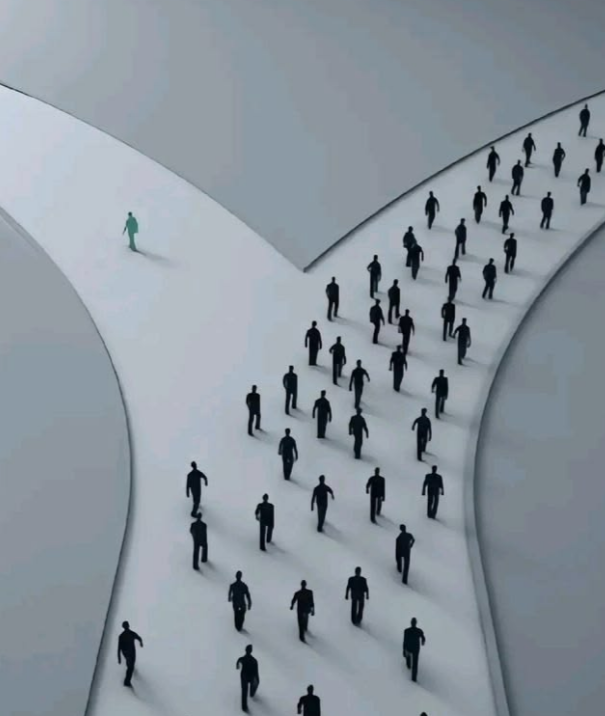
Imagine you are walikung down a street and suddenly see fifty people staring at the sky. You dint know what they are looking at. So you look up too. You might not even care about the sky. But fifty people can't be all wrong... right?
Welcome to conformity.
Humans are social animals. We constantly use others people's behaviour as information. Psychologist Soloman Asch demonstrated this famously un his conformity experiments. Participants has to identify which line matched another line in length. The answer was ridiculously obvious.
Then the other people in the room deliberately gave the wrong answer. A surprising number of participants went along with the group anyways. Nobody forced them. Nobody threatened them. They simply didn't want the be the one person saying Guys...are we seriously pretending that these lines are off same length?
This tells us something uncomfortable with ourselves. We don't only look to other to know if this is the truth. Soemtimes we look to other to decide what we are allowed to beleive.
And that is where the narrative becomes dangerous. A narrative is a particular way if framing a situation.
The same event can be described as A protest demanding justice or A violent crowd causing chaos.
The facts may overlap but the emotional interpretation can be completely different. Once a narrative becomes dominant, people often start interpreting new information through it.
If you already beleive someone is a hero then their mistake becomes an accident.
If you believe that they are villain then the same mistake can become an evidence of their character.
This is connected to confirmation bias...our tendency to notice and favour information that supports what we already beleive.
Social media makes this dramatically worse. The algorithms are made to show you the videos that makes you think that everyone think the same as you.
So you start beleiving Obviously everyone agrees with me. I have to be right.
Meanwhile, other person is sitting in a completely different digital universe, seeing thousands of posts proving that they are obviously correct.
Both groups think that they represent reality. That is how echo chambers work. And once a group becomes emotionally attached to a narrative, questioning it can feel like a betrayal.
That is the frightening part.
A person may defend an idea not because they independently examined the evidence but because the idea has becomes th eoart it their identity.
Following the crowd is not always wrong.
Imagine a smoke coming from a building. Everyone runs away from the building. You should not be looking at the scientific research investigation before leaving.
Social learning is useful. Other people can posses information that we don't posses.
The crowd can be right. The crowd can be wrong. The skill is being able to stand inside a crowd and still ask Why do I believe this? Not How many people believe this?
Why we become different around different people

Think about yourself with your parents. Now think about yourself with your closest friends. Now imagine yourself at your job interview.
Same person. Completely different software.
With your friends you might be loud and ridiculous and capable of laughing at absolutely nothing.
With your parents you might become a human being who has apparantly naver made a bad decision. At work you carefully chosen your words. Around a person you admire you become quiter than usual.
So which verison is the real you?
probably all of them.
Humans naturally adjust their behaviour depending on the social situation. Psychologist describe this party through self presentation the way people consciously manage how others perceive them.
We do it because humans are social animals. We need acceptance and cooperation and respect and belonging.
Imagin elakimg into a job interview and speaking exactly the way you speak with your best friends. Technically you are being authentic. Practically you are not getting a job. Changing your behavyi not automatically fake. It can be social intelligence.
You speak differently to a child than to your manager. You behave differently at a funeral than at the birthday party. You have to careful around someone who is grieving and more playful than around someone who is celebrating.
That is not hypocrisy. It is understanding context.
But there is a darker side. Sometimes we fint simply adjust our behaviour. We completely manufacture ourselves. You laugh at jokes you hate. You agree with the opinions you fine beleive. Pretend to enjoy things because everyone enjoys it. Becomes overly confident around insecure people. Become submissive around powerful people. Actually wealthy around people youa re trying to impress.
Eventually you can become so focused on what others see that you don't know what you want.
Your LinkedIn personality is different than your Instagram personality. Your family performance is difference than your friend group personality.
Your professional personality is different from the version of you lying in your bed at 2 a.m questioning every decision you make.
The real question is
Are you adopting or are you disappearing?
Adaptation is healthy when you change your communication while keeping you values. Pretending to be intrested is something because it is polite is different than abondoning your principle to gain someone's approval. Being professional is different than becoming someone you hate. Being respectful is different than becoming submissive. Being flexible is different than having no personality.